Overview
How might students without a car get off campus quickly, fairly, and safely?
As a team of 3, our goal was to turn one local problem at Livingstone College into a complete two-sided product.
Product Strategy
Finding a pricing and trust model that works between classmates.
Prototyping & Testing
76 screens, 13 flows, and a clickable prototype for riders and drivers.
Iterating with Feedback
Auditing our first screens and rebuilding them on one system.
Problem: the wait is longer than the ride.
One day I needed to get to Walmart from campus. The shuttle wasn't around, so I ordered an Uber. I waited about 10 minutes to be matched, then about 15 more for the driver to arrive. About 25 minutes of waiting for a 7 minute ride.
Opportunity: the drivers are already on campus.
Plenty of students have cars and would drive a classmate for a few dollars. They already do it in group chats. What's missing is trust, a fair price, and a way to find each other fast.
Closer drivers
A classmate down the hall instead of a driver across town.
Verified community
Every rider and driver is a verified student.
A fair price
The rider names it, drivers accept or counter.
Solution
Introducing Campus Ride: the ride you agree on before you get in.
A mobile app where a rider names a price, nearby student drivers accept or counter, and the rider picks who to ride with.
Campus Ride works on both sides of the ride.
Riders set a price and pick a driver. Students with cars go online between classes and choose the requests they want.
Core flows
Name your price
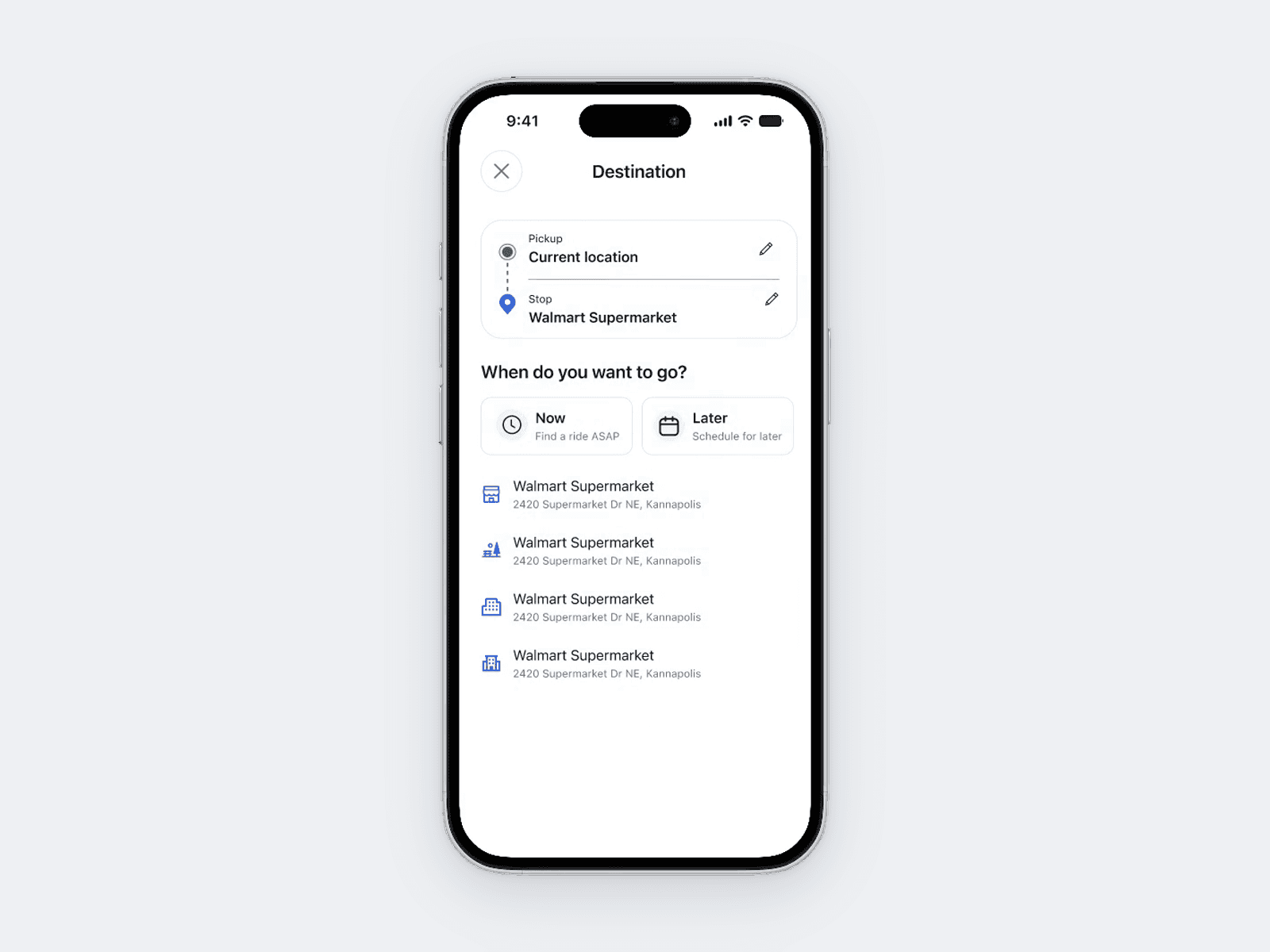
Pick where you're going, see a suggested price, and set your own offer.
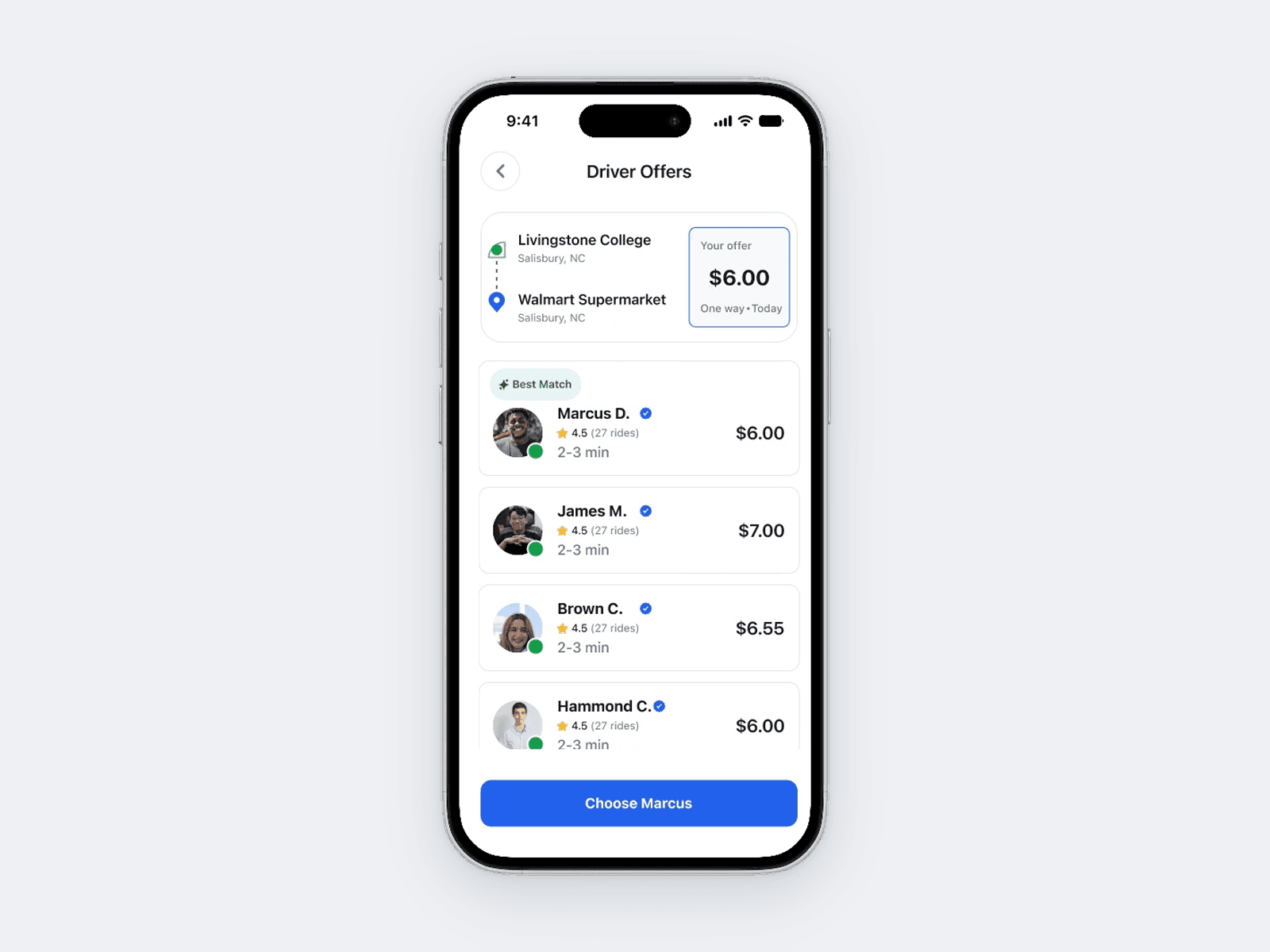
Pick your driver
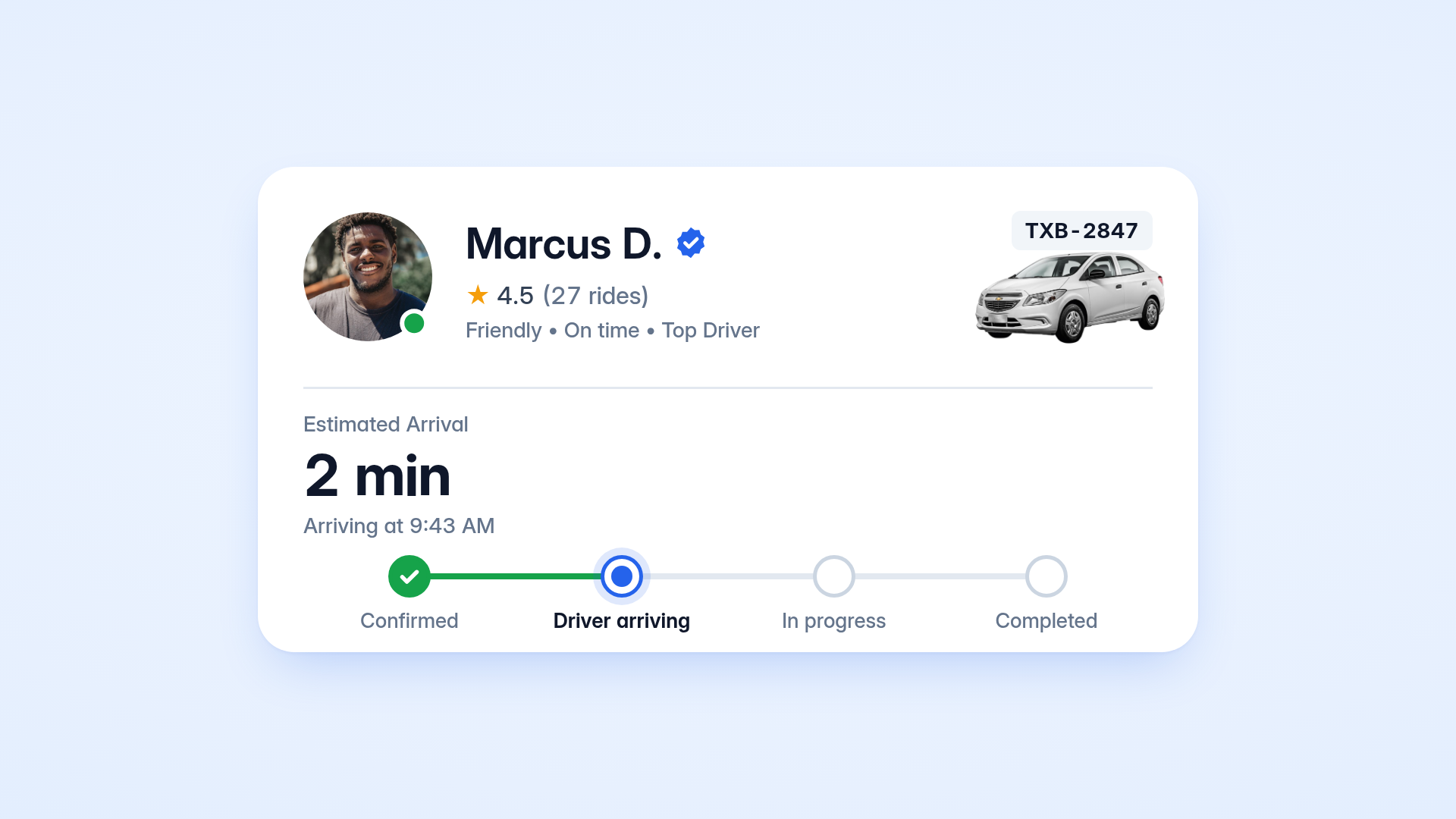
Compare verified student drivers by rating, ETA, and price. Marcus accepts $6.00 and he's on the way.
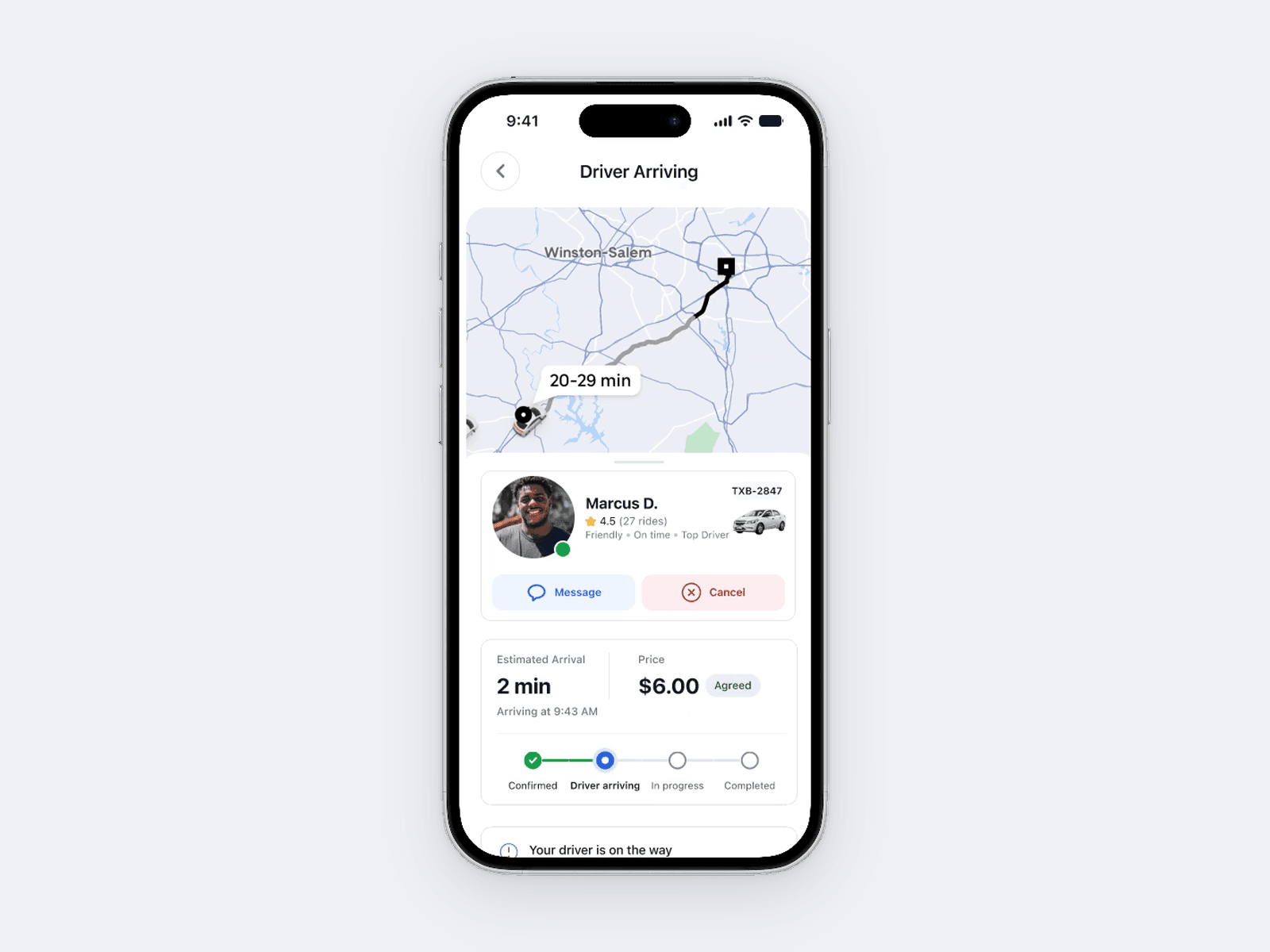
Ride with confidence
Message your driver, open the safety sheet anytime, then rate the ride.
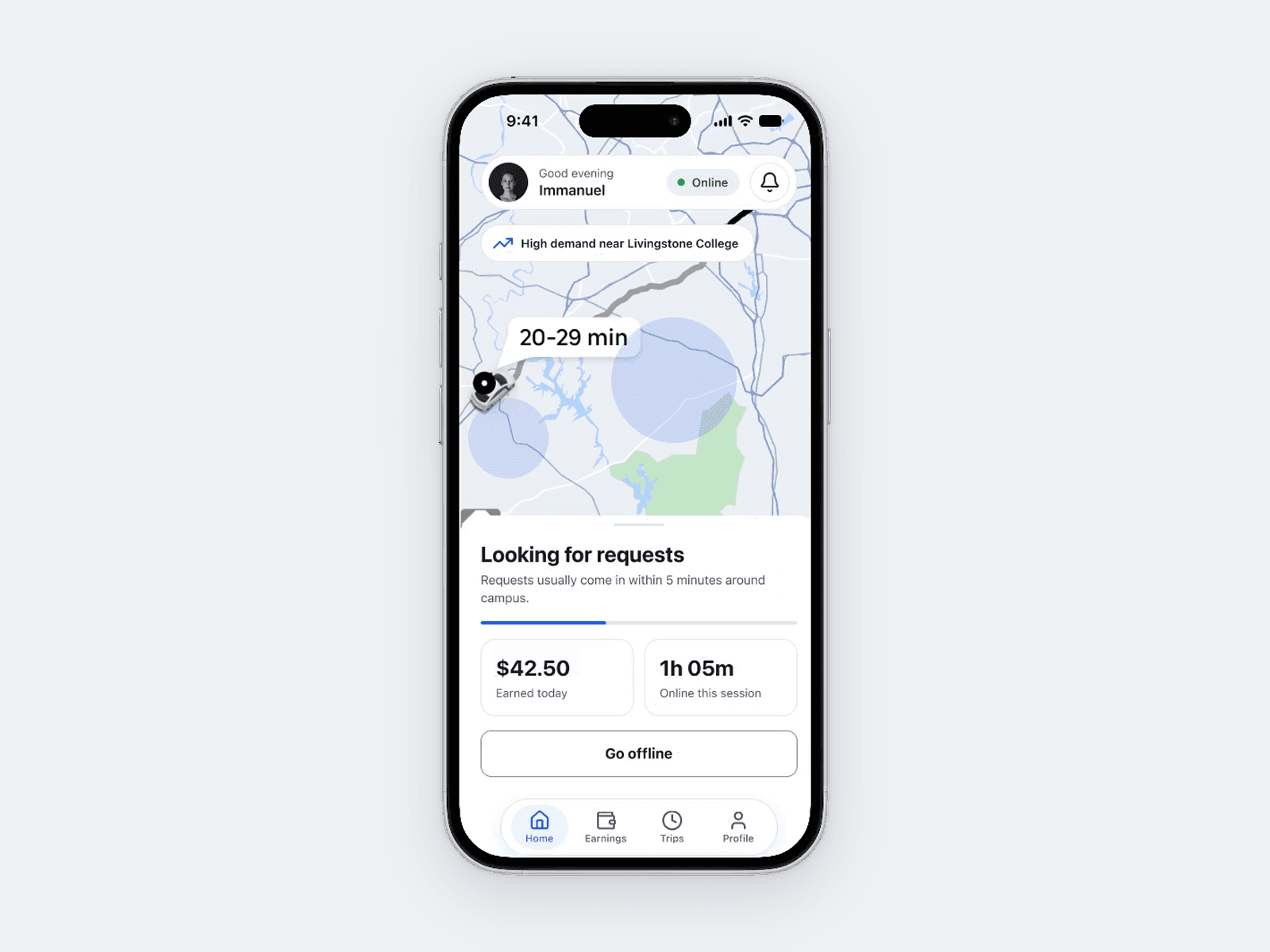
Drive between classes
Go online, get a request with a countdown, and navigate to a classmate.
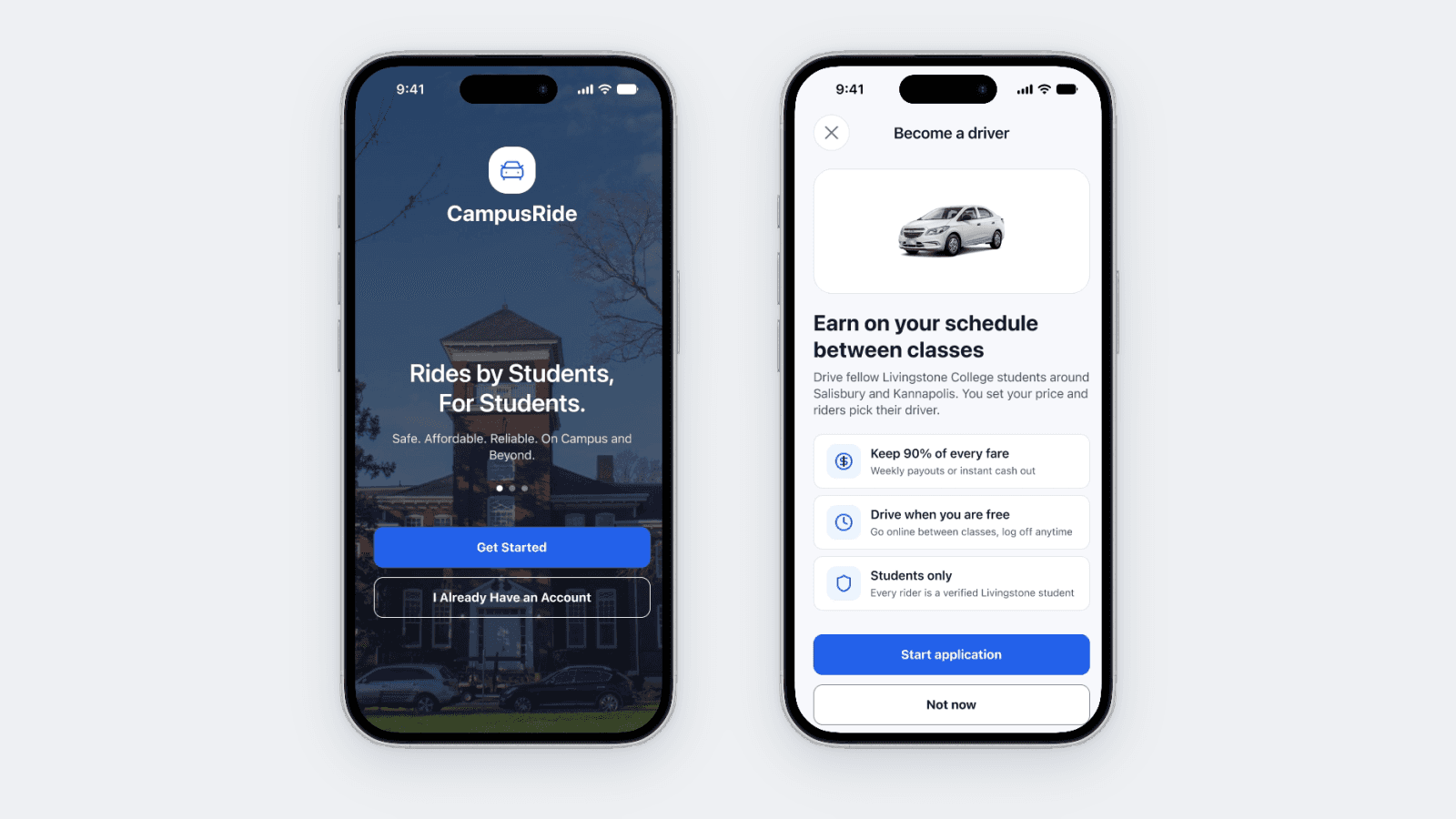
Onboarding to Campus Ride
Proving you belong to the campus before you ever see a driver, for riders and for students who apply to drive.
Research
We researched how students at Livingstone actually get around.
We dug into the campus shuttle, Salisbury's buses and microtransit, ride hailing in small towns, and apps that tried this before. Then we found the clearest proof in our own dorm group chat.
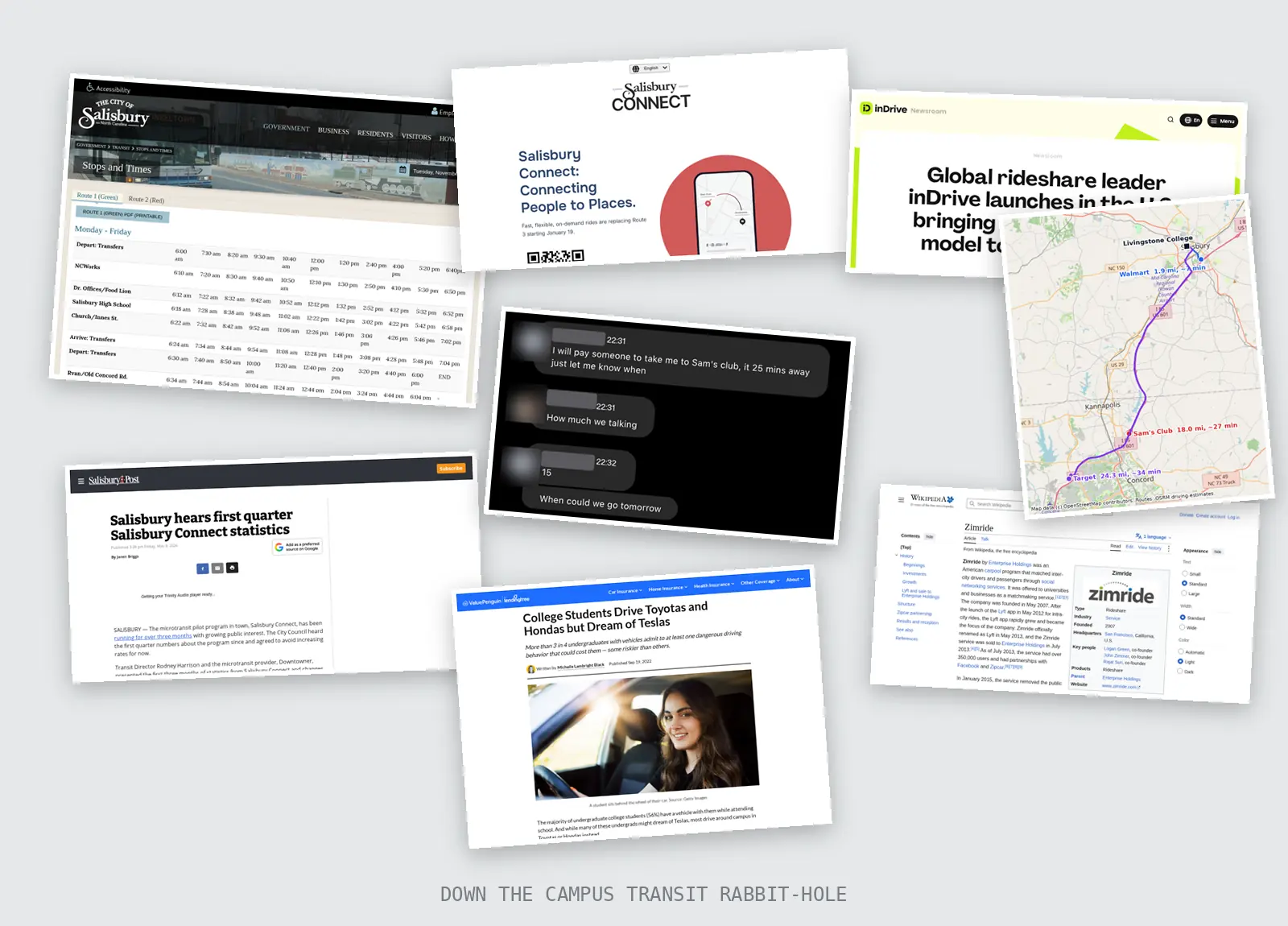
In the chat, a student wrote "I will pay someone to take me to Sam's club, it 25 mins away." Someone asked "How much we talking." The answer: "15." Students already name a price for rides. They just do it by hand.
Livingstone shuttle
Designated routes and approved activities. When it isn't around, you're on your own. [1]
Salisbury Transit buses
Two weekday routes, last trips around 7 pm, Saturday service suspended. [2][3]
Salisbury Connect
On demand, Monday to Friday, 6 am to 7 pm, within a set area. [4]
Uber or Lyft
Fewer drivers in small towns. 19% of rural Americans use ride hailing vs 45% urban (Pew). [5]
Group chats
No trust, no tracking, no payment, no guaranteed reply.
Walmart is 1.9 miles from campus. Sam's Club is 18 miles away in Kannapolis, about 27 minutes by car, which matches the "25 mins" in the chat. [6] Zimride proved closed student networks build trust [7], and inDrive proved riders can name the price [8].
Explorations
Exploring how a ride should be priced
Fixed fare
Fast and familiar, but wrong for classmates on tight budgets.
Driver bids
Fair to drivers, but riders can't plan and get surprised.
Rider names the price
The rider proposes, drivers accept or counter.

Why name your price?
It's already happening
Students name prices in group chats today.
No surprise at the end
The rider knows the cost before booking.
Drivers keep a voice
Counter offers keep it fair on both sides.

Testing
Testing and iterating with feedback!
We are putting the prototype in front of students, watching how they book, and listening.
Session video coming soon
Session video coming soon
Session video coming soon
Session video coming soon
System
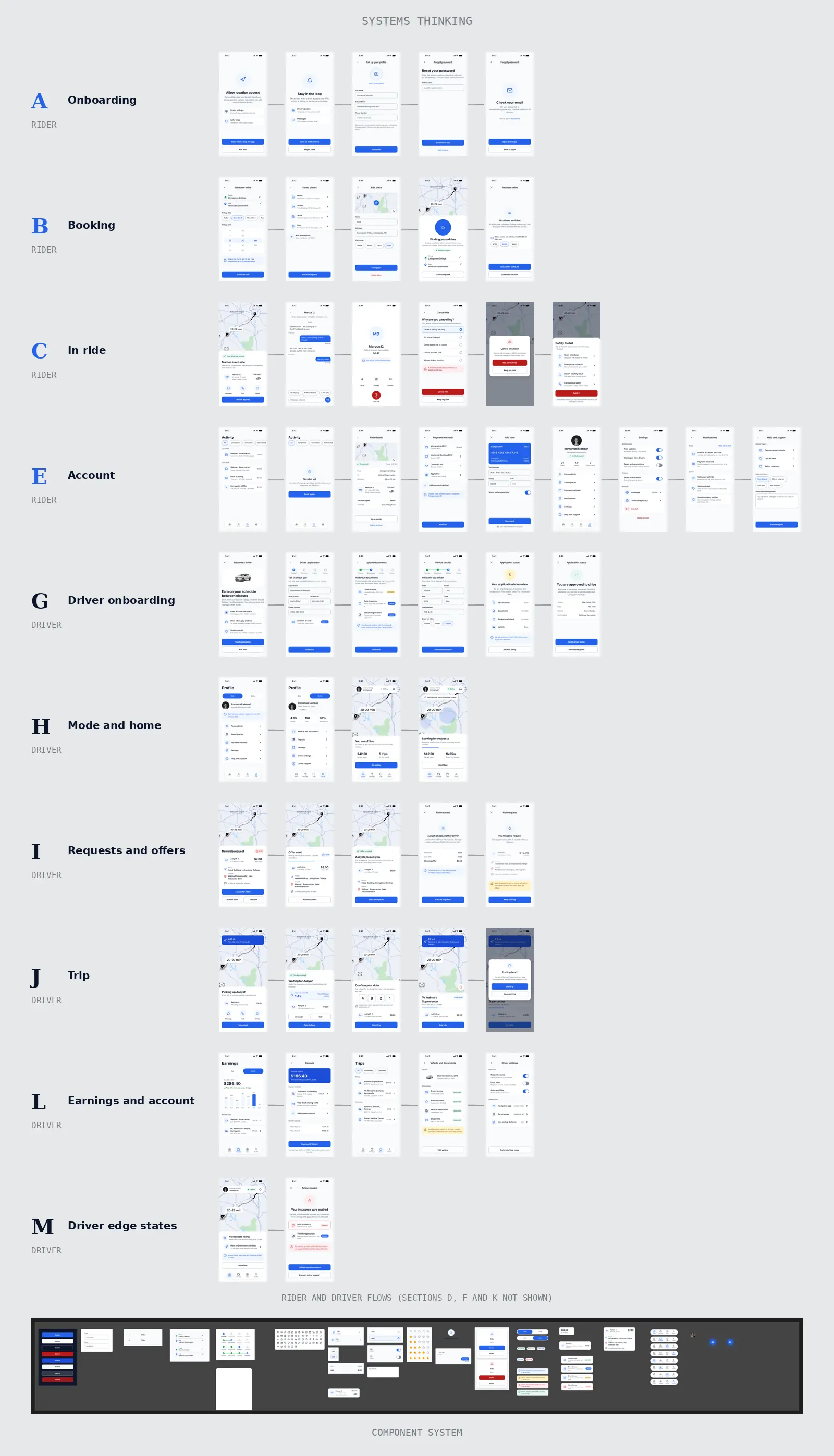
We designed a system, not just screens.
Every flow for riders and drivers sits on one set of components, so the 76th screen is as consistent as the first.

Constraints
A ride on every offer isn't possible, yet.
Name your price only works if someone says yes. A low offer, a busy afternoon, or a driver who loses out can break the whole idea.
Rider-side recovery
When no driver accepts, the rider gets clear ways forward instead of a dead end.

How do I help riders raise a fair offer?
Show what nearby riders are offering, with quick picks and "Raise offer" as the main action.
What if they can't pay more?
"Schedule for later" keeps the trip alive instead of ending it.
Driver-side negotiation
Drivers see each request with a countdown and can accept, decline, or counter.

How do drivers decide fast?
The rider's offer, pickup, dropoff, distance, and a 12 second timer on one card.
What does losing feel like?
"Rider chose someone else" shows the winning offer, so drivers learn instead of guessing.
What if they miss it?
"You missed a request" closes the loop and keeps them ready for the next one.
Outcomes
Estimated impact
25 min
My wait today: about 10 min to match, plus about 15 min for pickup.
4 to 10 min
Estimated wait with Campus Ride: 2 to 5 min to get an accepted offer, plus 2 to 5 min pickup by a driver already on campus.
That's an estimated 60% to 84% less waiting. The comparison is (25 minus 10) / 25 and (25 minus 4) / 25. These are assumptions, not measured results. I will replace them with real numbers from student feedback.
Reflection
What I learned
The best research was already in our group chat.
Real behavior beats assumptions.
Design the "no," not just the "yes."
Name your price lives or dies on what happens when nobody accepts. Designing "No drivers available" and "Rider chose someone else" made the idea honest.
Audit before you scale.
Fixing the first 11 screens was cheap. Fixing all of them would not have been. The system is why the driver side came together fast.
When a screen keeps moving, it might be two screens.
Choosing a place and agreeing on a price needed their own screens.
SOURCES
[1] Livingstone shuttle driver posting [2] Salisbury Transit stops and times [3] Salisbury Transit [4] Salisbury Connect, Salisbury Post [5] Vox citing Pew [6] Routes: OpenStreetMap contributors and OSRM [7] Zimride, Fast Company [8] inDrive. Also: ValuePenguin student car survey.
Photos (Wikimedia Commons): Livingstone College from Monroe St and the bear (CC BY-SA 3.0), PCC shuttle bus (CC BY-SA 4.0), City Bus in Winston-Salem (CC BY-SA 4.0), Uber iPhone app (CC0), GCC parking lot (CC BY 2.0). The collage shows screenshots of the cited pages.