Overview
Important updates get missed.
The SRC IT and Innovation Committee says students miss them when they rely on WhatsApp groups, cluttered emails, notice boards, social media pages, and word of mouth [1]. 76,126 is the University of Ghana's official 2024/2025 enrollment, from the IRPO enrollment statistics [14].
I led the design of the UGSRC App end to end. That meant the whole experience, not a set of screens: how the app is structured, how people move through it, and how every feature connects.
Product structure.
Eight connected flows organized around one Home screen and five tabs.
End to end flows.
Sign in, find a pasco, ask a question, file a complaint, and follow it to a reply.
A connected system.
One set of components, colors and patterns shared by every feature, in four themes.
Problem: Official SRC information is spread across too many places, and students have no clear line back to the SRC.
The SRC's own IT & Innovation Committee put it plainly: students rely on "WhatsApp groups, cluttered emails, notice boards, social media pages, and word of mouth," so "important updates get missed, academic resources are scattered, and official SRC communication is not always easy to find" [1]. Even the university's Academic Affairs office says some students "still miss these essential updates" [2]. Past questions sit behind a library portal with a 48 hour registration wait, or in shared Drive folders [3]. Issues reach the SRC through one-off campaigns [4].
Opportunity: Give the SRC one official channel that students can read, use and talk back to.
If the SRC owns one app, announcements are verified at the source, study material lives next to the news, and every complaint becomes a ticket someone has to answer. Students get one place to go. The SRC gets one place to listen.
Find it fast.
Updates, events, clubs, leaders and scholarships from one Home screen.
Get answers.
Past questions on demand and an AI companion for how-to questions.
Be heard.
Complaints, suggestions and questions, anonymous if needed, tracked to a reply.
Solution
Introducing the UGSRC App: the SRC, in every student's pocket.
One app for SRC news, past questions, campus answers and direct feedback, built on a single design system for students and SRC officers.
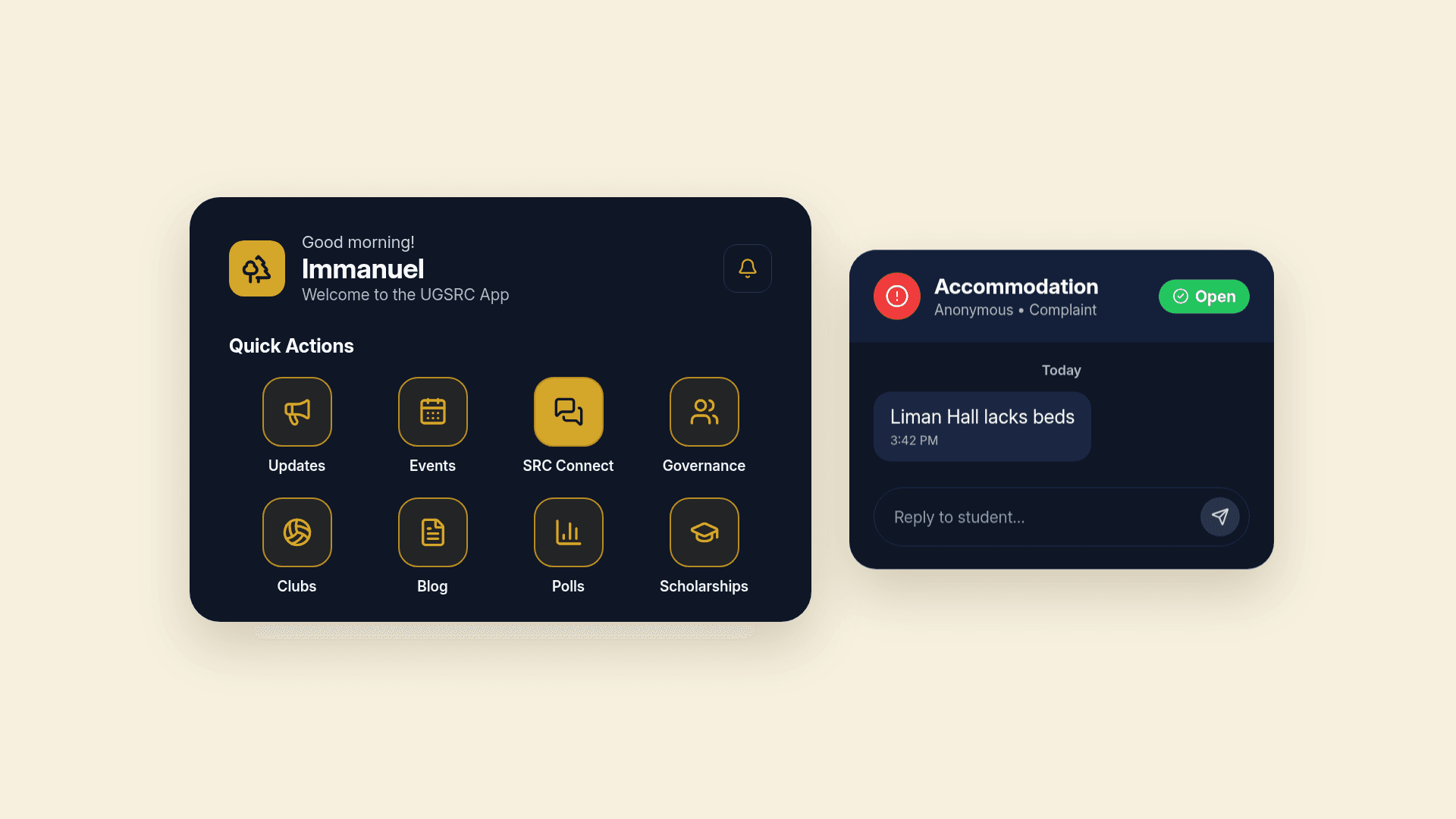
Built for students first, with an officer side so the SRC can reply.
Core flows
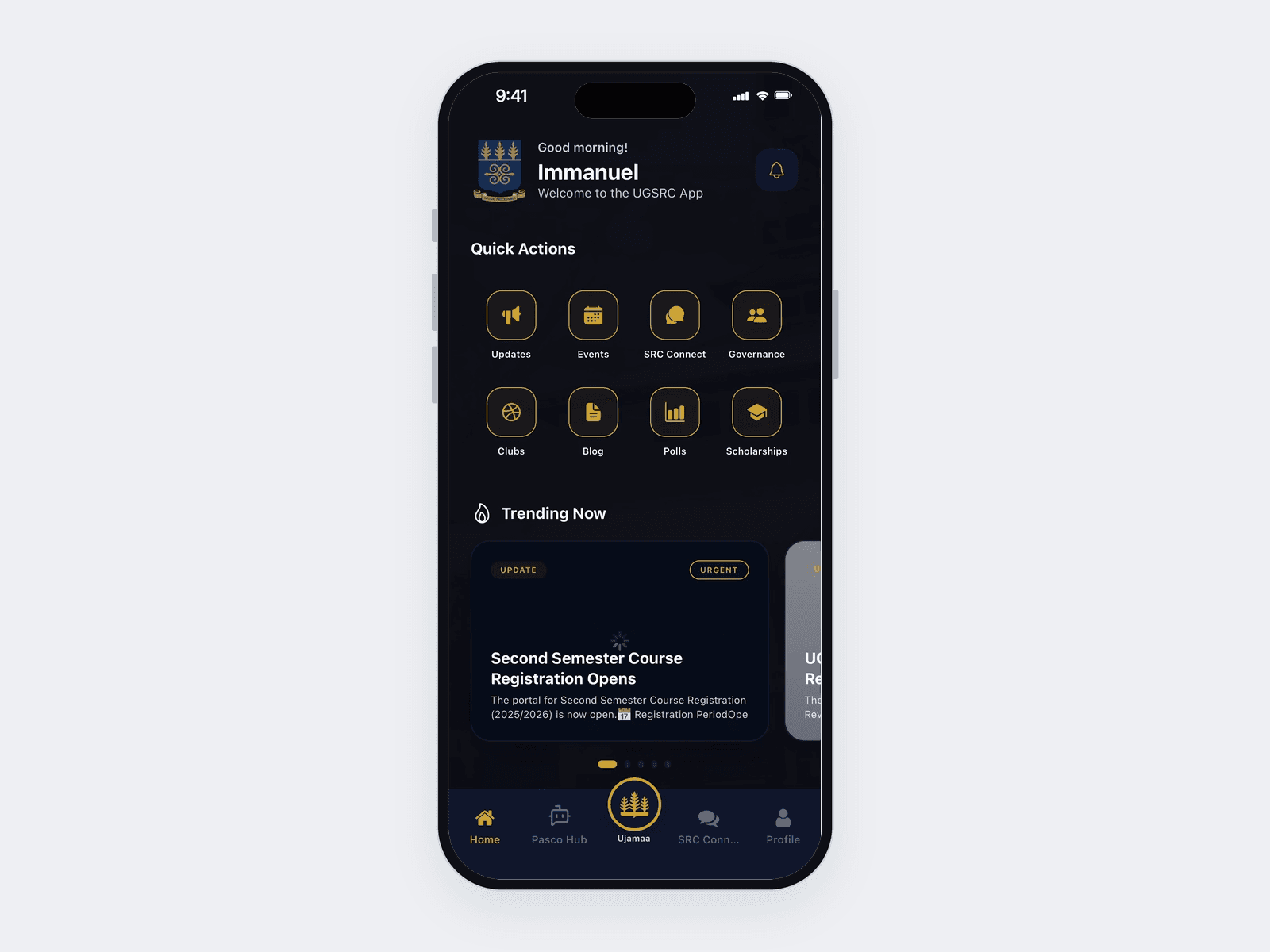
Home and quick actions
A greeting, eight quick actions, Trending Now and the latest updates and events. Every service starts here.
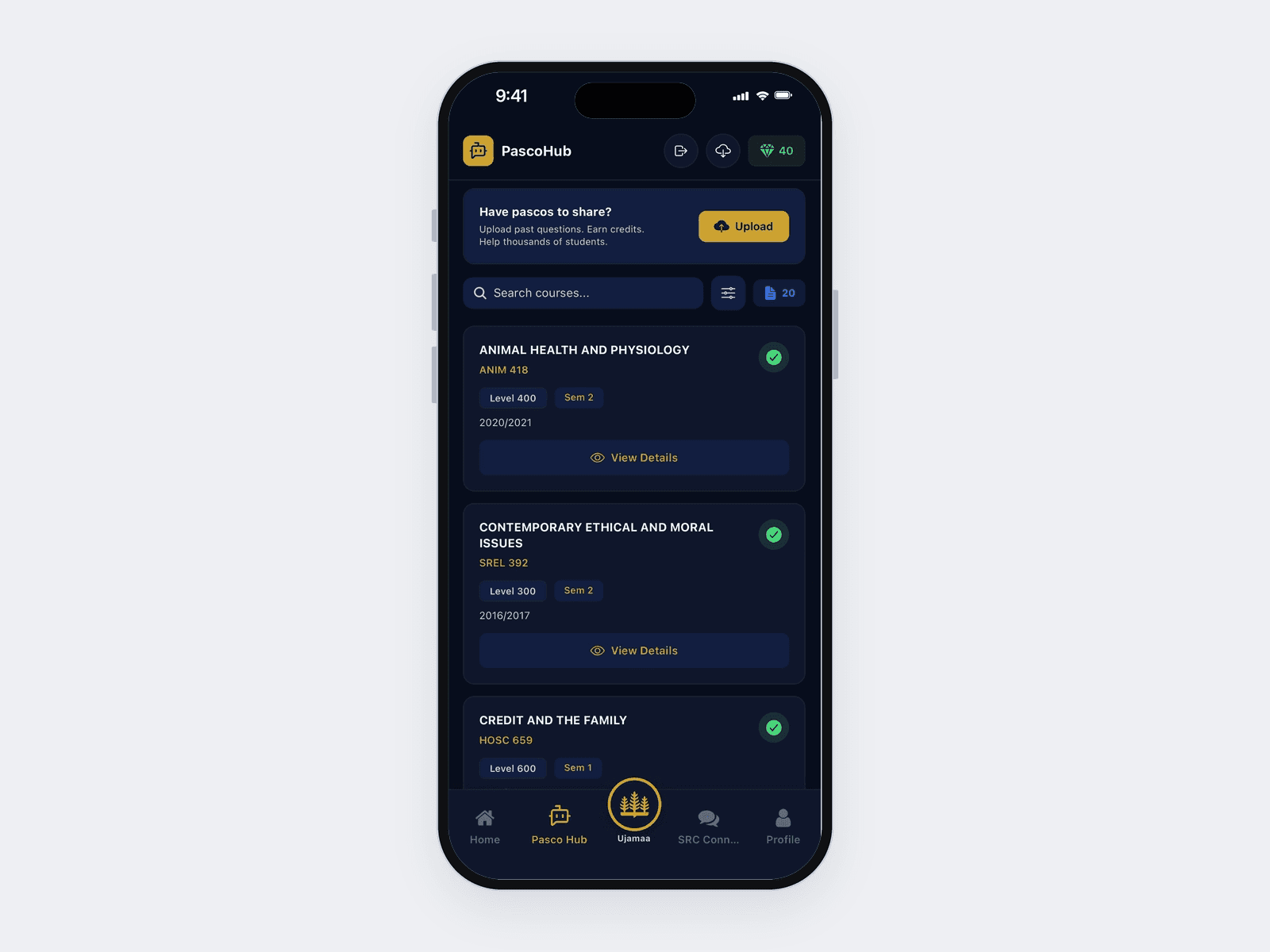
PascoHub
Search past questions by course, preview, download for offline use, and earn credits by uploading.
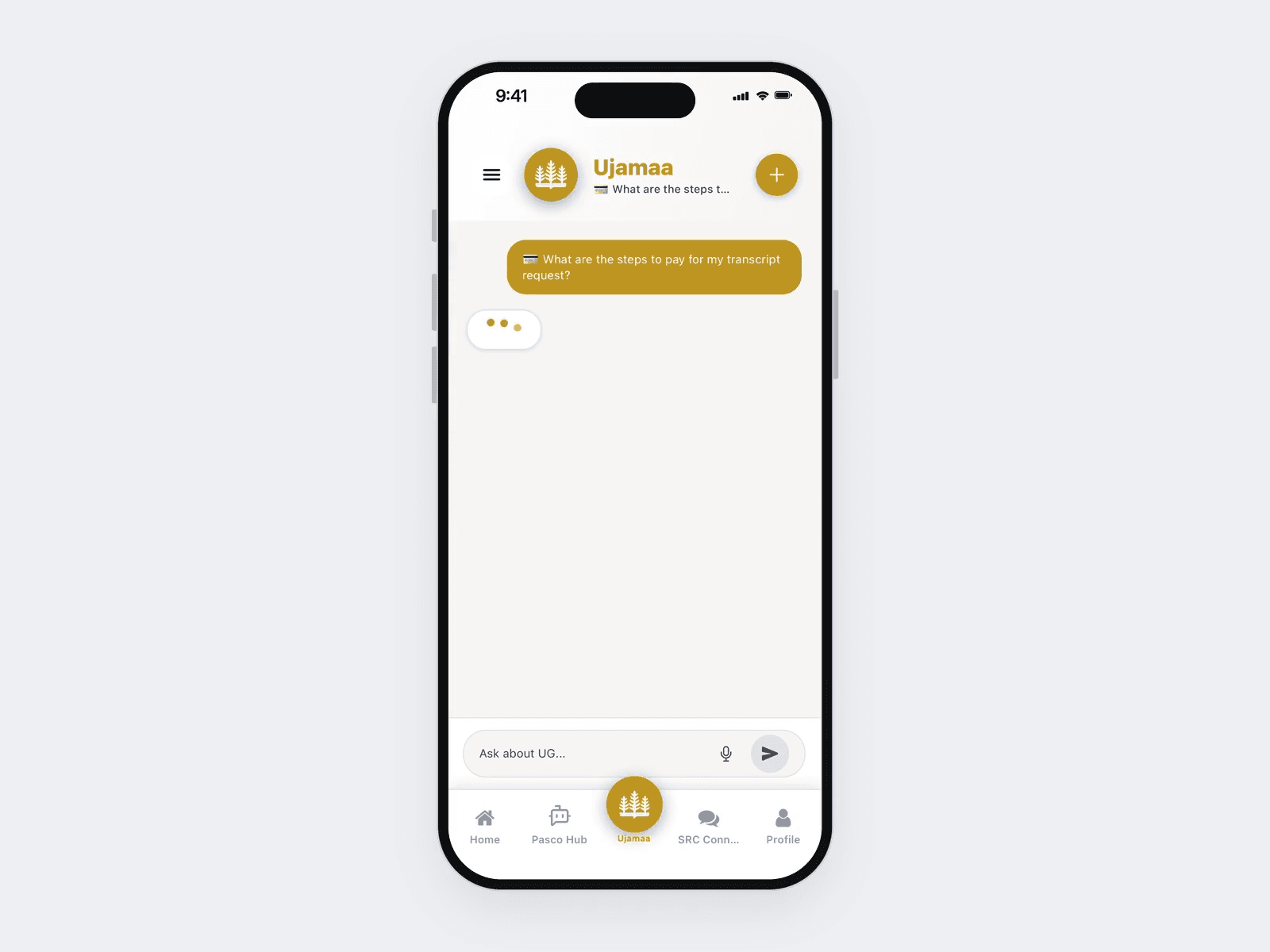
Ujamaa
An AI campus companion that walks students through UG processes, and answers in Twi when asked. The clip shows the transcript steps.
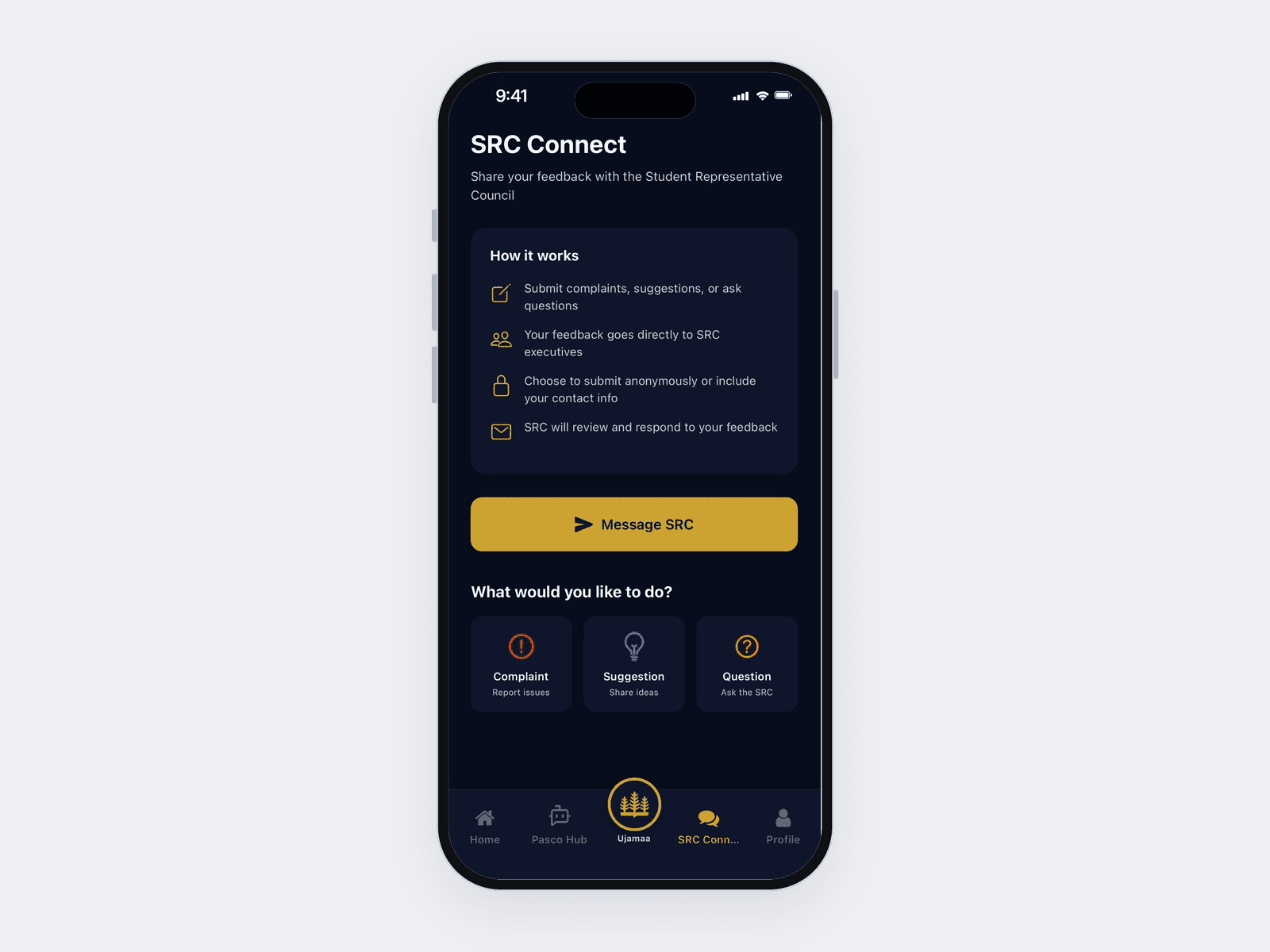
SRC Connect
File a complaint, suggestion or question, choose to stay anonymous, and follow it as a live thread.
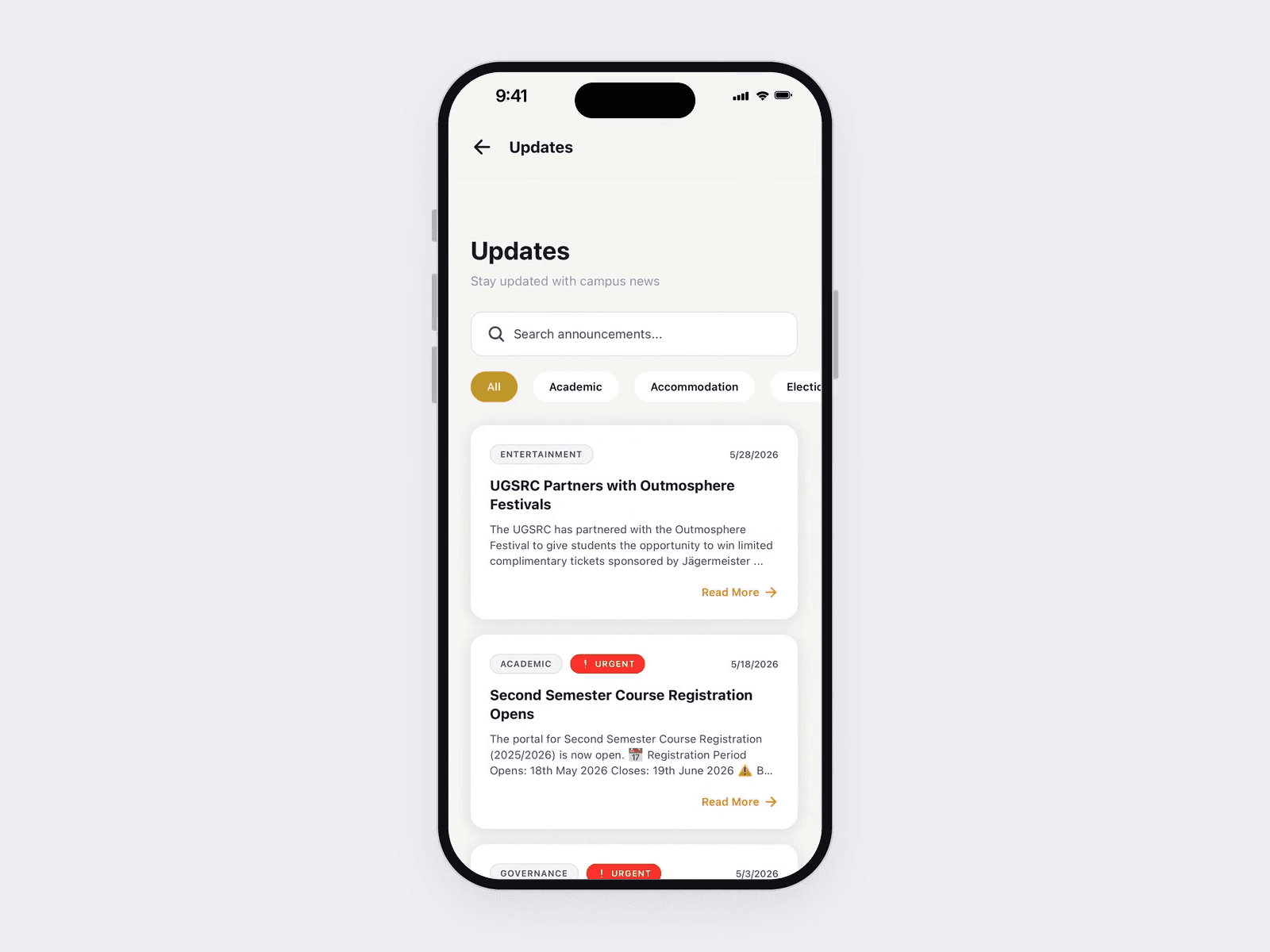
Updates, Events and Clubs
Category filters for announcements, a dated timeline for events, and every student organization in one list.
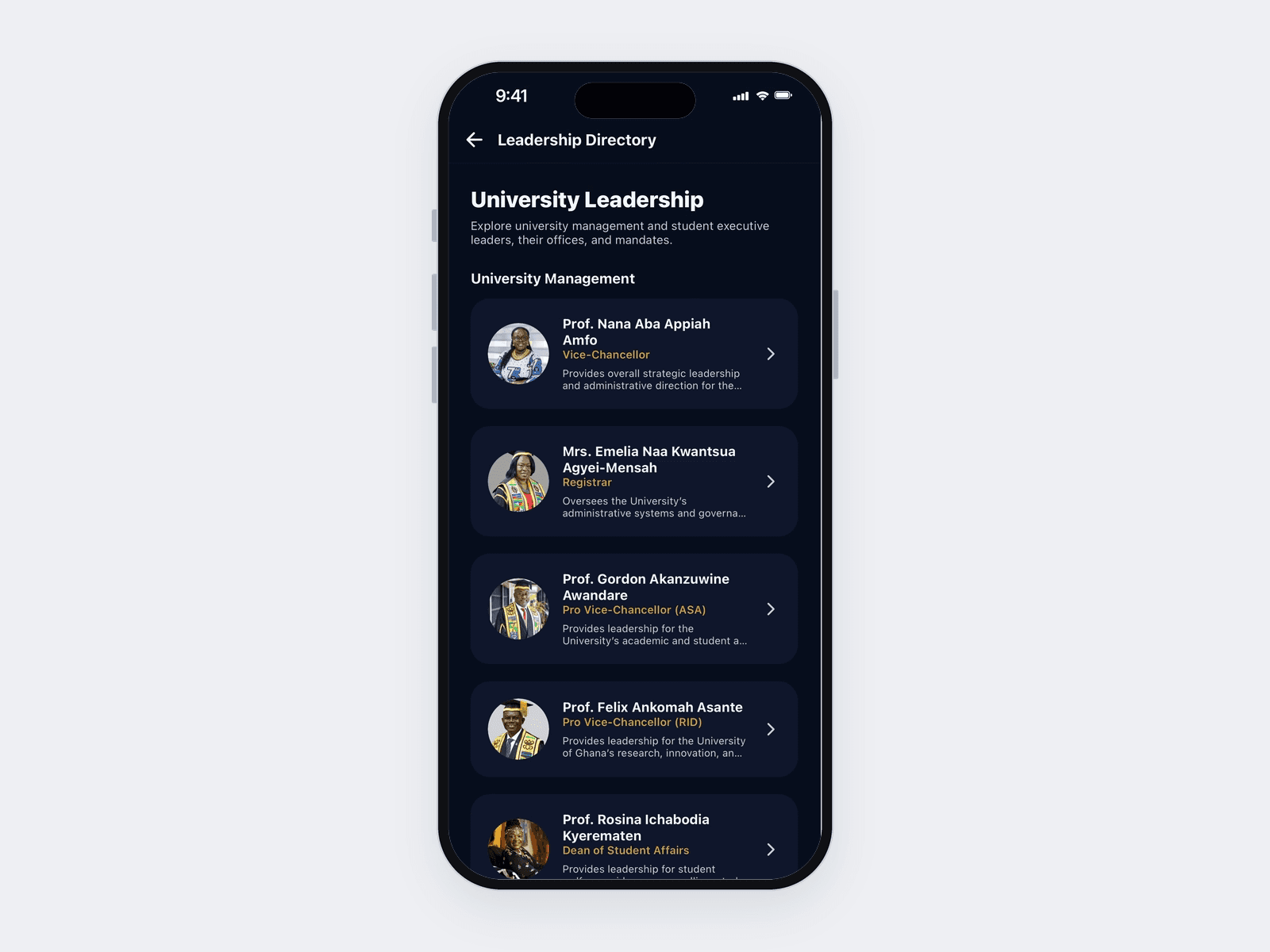
Governance and Scholarships
A directory of university management and SRC executives, and open funding with amount, deadline and requirements.
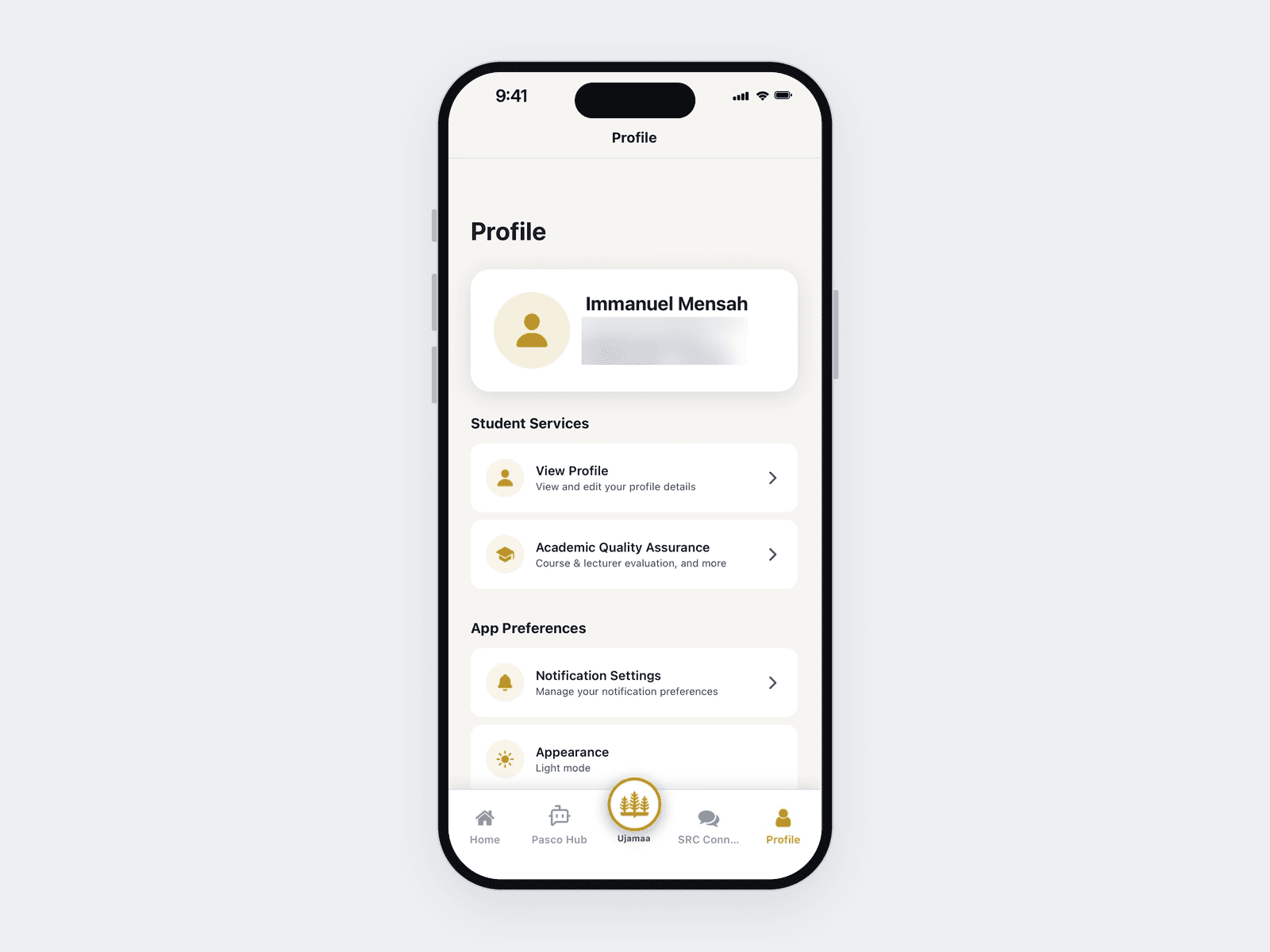
Profile and themes
See your verified account, reach Course and Lecturer Evaluation, and switch between Light, Dark, System and Slate.
Onboarding
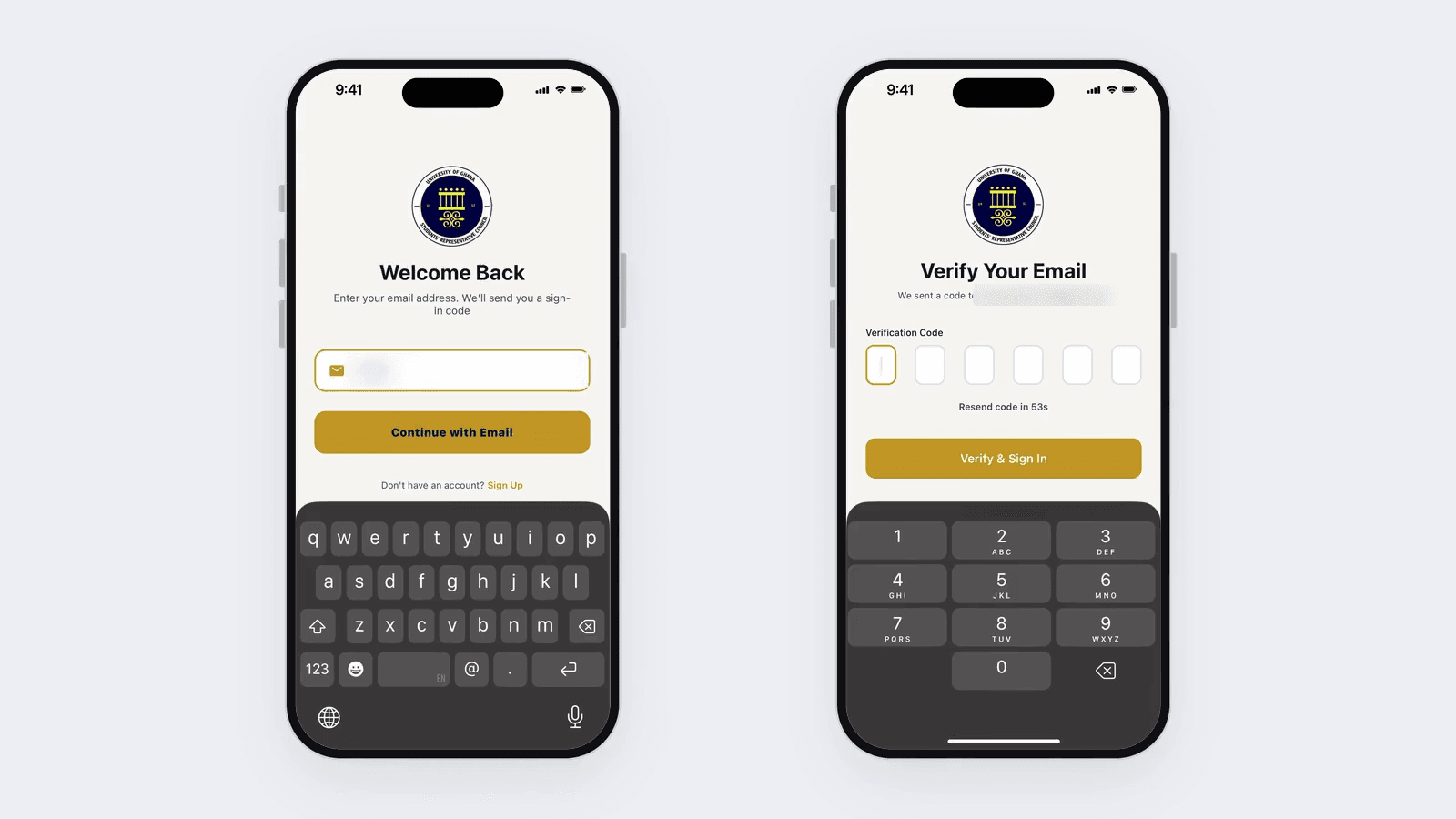
Enter your email, get a one-time code, and you are in. No password to forget.
Research
For this case study I pulled together what the SRC, the university and published research already say about how students get information.
What I found
- 1Students already say the channels are scattered.The SRC's own launch post lists five channels students juggle [1]. Academic Affairs started a WhatsApp channel because people miss notices [2].
- 2WhatsApp is where students are, and it is noisy.In a survey of 420 UG undergraduates, WhatsApp was the most used platform for academic purposes [5]. A 2026 survey of 454 UG undergraduates found "information overload and unequal participation" were the main problems with WhatsApp groups [6].
- 3Past questions are essential and hard to reach.The official route needs registration, a 48 hour wait and a second login per paper [3]. Students fill the gap with Drive links and unofficial sites.
- 4Students have a lot to raise.One SRC academic campaign collected 503 concerns, from results to scholarships [4]. In November 2026 the SRC and GRASAG told students to rely only on official SRC channels during a hostel fee dispute [7].
- 5University services are split across portals.MIS Web, Sakai, the STS portal and the halls portal each have their own login [8]. The university's earlier app, UGMobile, left the iOS App Store in 2024 [9].
- 6One app with AI is where campus software is heading.Platforms like Modo Campus and ReadyCampus sell one mobile front door with an AI assistant [10][11]. Georgia State's AI text assistant cut summer melt by 21.4% in a randomized study [12].
How it compares
| Channel | Official news | Past questions | Ask a question | Reach the SRC | Anonymous |
|---|---|---|---|---|---|
| WhatsApp groups | Mixed with chat | Shared files | Peers | Indirect | No |
| UG portals (MIS Web, STS, Balme) | Partly | Yes, 48h wait | No | No | No |
| Vendor campus apps (Modo, ReadyCampus) | Yes | No | AI assistant | Not student-government led | Varies |
| UGSRC App | Yes, from the SRC | Yes, plus uploads | Ujamaa | SRC Connect | Yes |
Who I designed for
Hypotheses, not interviewed personas.
- 01A fresher who does not yet know which portal does what.
- 02A continuing student near exams who needs pascos fast, offline, on limited data.
- 03A student with a welfare issue who wants to report it without being named.
- 04An SRC officer who needs issues sorted and a way to reply.
Explorations
These are the main decisions I weighed while structuring the app.
One hub or separate apps.
Pascos, AI and feedback could each be their own app. I chose one hub so a student installs once and sees SRC news on the way to every task.
Chatbot or FAQ page.
A FAQ is easy to keep correct but hard to search. A chatbot is easy to ask but can make things up. I chose a chatbot that answers only from verified SRC and university documents and says so when it does not know [13].
Public or anonymous feedback.
Named feedback is easier to follow up. Anonymous feedback lowers the cost of speaking up. I made anonymity a toggle on every submission, so the student decides per issue.
Tab structure.
Five tabs: Home, PascoHub, Ujamaa, SRC Connect, Profile. Ujamaa sits in the center as a raised gold button because it is the one place you can start any question. Less frequent services (Clubs, Governance, Blog, Polls, Scholarships) live in Home's quick actions instead of competing for a tab.
Why one app?
One front door.
Email code to get in, then every service from Home.
One source of truth.
If it is in the app, it came from the SRC.
One loop.
Read an update, ask about it, respond to it, without leaving.
System
We designed a system, not just screens.
- AHome:greeting, quick actions, Trending Now, latest updates and events.
- BPascoHub:sign in, search, preview, download, offline library, upload, credits.
- CUjamaa:suggested prompts or voice, answer, follow up, change language, report an answer.
- DSRC Connect:choose type, title, category, description, anonymous toggle, submit, ticket, thread, officer reply.
- EUpdates, Events and Clubs:filter, read, comment, browse organizations.
- FGovernance and Scholarships:leadership directory, browse funding, detail, apply.
- GProfile:profile, Course and Lecturer Evaluation, notifications and quiet hours, themes.
- HOnboarding:email, one-time code, academic details, Home.
COMPONENTS
Color
Deep navy brand, mustard gold for primary actions, type colors for feedback (red complaint, purple suggestion, orange question), green status pills.
Themes
Light, Dark, System and Slate, all from the same tokens.
Navigation
Five-tab bottom bar with a raised center action.
Cards
Rounded content cards for updates, events, pascos, clubs and scholarships.
Chips and pills
Category filters, status (Open), level and semester tags, verified badges.
Bottom sheets
Feedback type picker, confirmations.
Inputs
One-time code boxes, search bars, toggle rows, chat composer with voice.
States
Success screens, empty states, loading, offline downloads.
Constraints
CONSIDERATIONS
How do students raise sensitive issues without fear?
Anonymity is a toggle on every submission, and the issue still becomes a tracked ticket with an Open status and a thread, so anonymous does not mean ignored.
How does an AI assistant stay trustworthy?
Ujamaa answers from a curated set of verified documents, says plainly when it has no verified answer, and lets students report a wrong one [13].
How do pascos stay free to grow but fair to use?
A credit system: upload a reviewed paper to earn credits, spend credits to download. Downloads work offline for students on limited data.
How do I keep study activity private?
PascoHub has its own sign-in by design, so a student's past-questions activity stays separate from their main account, as the app's privacy policy sets out [13]. A deliberate privacy decision, for one extra step.
How do officers keep up with volume?
Every submission carries a type and a category (Academic, Welfare, Facilities and more), so it can be routed to the right executive.
How do students avoid notification overload?
Students switch categories on or off and set quiet hours. Urgent announcements can still get through [13].
Outcomes
Published on both the App Store and Google Play, but not yet open to students pending administrative checks.
The app is complete and running on University of Ghana infrastructure [13]. Because it is not yet open to students, there are no usage numbers to share, and I have not estimated any.
What I'd measure next
- 01Weekly active students as a share of enrollment.
- 02Time from an SRC Connect submission to the first officer reply.
- 03Share of tickets resolved, by category.
- 04Share of anonymous submissions.
- 05Ujamaa questions answered without a "no verified info" reply, and answers reported.
- 06Pasco downloads per exam period, and uploads approved.
- 07Notification opt-out rate by category.
Reflection
What I learned
Design the system first.
With this many services, the hard part was deciding where things live. Once the structure and components were set, each new feature was quicker to design.
Trust is a design feature.
Verified content, an AI that admits what it does not know, and a ticket that always gets a status matter more than any single screen.
Anonymity needs a loop.
Letting students hide their name only works if they can still see their issue move.
Privacy can be worth a step.
Giving PascoHub its own sign-in keeps study activity separate. Writing down why that step exists makes it easy to defend, and to revisit as the product grows.
Sources
1. UGSRC IT & Innovation Committee, "Why the UGSRC App Matters: Everything UG Students Can Now Do in One Place", in-app SRC Blog, Feb 4, 2026. (Not public on the web.)
2. University of Ghana Academic Affairs, "Stay updated with the new UG Academic Affairs WhatsApp channel".
3. Guides to Balme Library past exam papers. Sko Bureau and Asetena.
4. Radio Univers, "UGSRC tackles students' concerns through 2nd phase of 'LET's VIBE' initiative", Apr 17, 2024.
5. Bawa et al., "Social Media Usage and Coping Strategies among University of Ghana Undergraduate Students", Journal of Social Media for Learning, 2021.
6. Entsua-Mensah, Kwanya and Okyere, "WhatsApp groups as informal knowledge management platforms in African higher education", Information and Learning Sciences, 2026.
7. GRASAG-UG and UGSRC, "Joint communique on student accommodation concerns and proposed demonstration", Nov 1, 2026.
8. University of Ghana Apps Portal and STS transcript page.
9. AppBrain, "UGMobile for iPhone".
10. Modo Labs, "Modo Campus".
11. Ready Education, "ReadyCampus".
12. Harvard Graduate School of Education, "Smarter Tech to Smooth the Path to College", 2017.
13. UGSRC App Privacy Policy, updated Nov 3, 2026. support.ugsrcconnect.com.
14. University of Ghana IRPO, "Student Enrollment Statistics 2024/2025".
15. Photo: Sarah Shreeves, "Balme Library at University of Ghana, Legon", Wikimedia Commons, CC BY 2.0.